Monday, July 21, 2008
Walk a mile in her shoes
In the past, I've wondered where all of the "enlightened" people have gone. We all reference Christ and the Buddha, but that was sooooo long ago. Many make reference to more recent luminaries like Mahatma Gandhi, Martin Luther King, or Mother Theresa. But for those that are household names, the list is very short, don't you think? And we can use all the help (pointing the way) we can get.
Well here is one more that I just stumbled across the day before yesterday. The gentleman in this video (which is just my "teaser" -- I liked the short video) mentions a woman called Peace Pilgrim. Strange name, perhaps, but a fascinating story of modern-day enlightenment (at least that's how I see it). There is no doubt in my mind that she was in tune with that which prophets and sages and gurus and yogis describe. Her words and actions illustrate the results of attaining inner peace (loving-kindness, boundless energy, unbridled joy).
For those that wonder what modern-day, western-oriented enlightenment might look like ... what expressions it might result in ... what actions one might take ... what are some practical repercussions in the work-a-day world ... and the like, I commend this story of her life. It's really just a collection of her thoughts and insights, both written and spoken, pulled together in one place by some of her friends along her journey.
Read it with an open mind, and see if any of these messages resonate somewhere deep inside. I suspect we'll talk more about Peace Pilgrim in the future.
Namaste.


Wednesday, March 12, 2008
You can't make this stuff up

Are you familar with TED? T=Technology, E=Entertainment, and D=Design topics. The tag line is "Ideas worth spreading". They hold a conference each year, and cover an eclectic array of topics. They are always sold out. And the tickets cost $6,000.00 each.
The TED conference for 2008 was just recently held. They are just now beginning to post the talks online -- this wasn't so in the beginning, but thankfully, has now become the norm. This was the first talk they published this year.
I found it fascinating on a personal level. First -- because my father had a cerebral hemorrhage, and so, I wonder "what if". Second -- because I have briefly experienced this sense of oneness, and find it both comforting and encouraging when others experience it as well. Third -- because we get to hear it from a scientist, whose training is in this field. She sure doesn't talk like a scientist.
But rather than hearing my reactions, perhaps you just want to check out the talk for yourself. It runs 18 minutes -- so I suggest you get yourself a cup of tea.
Thursday, December 20, 2007
Religion vs. Spirituality
It is a common perspective. Certainly, I've viewed the world from this perspective for much of my adult life. If someone were to ask me, "are you a religious person?". I might say, "No, though I consider myself somewhat spiritual." What the heck does that mean, anyway?
And why, do I find myself coming back time and again, to castigating most religions -- or at least their dogmas? I guess it is the anti-consumer in me. I really don't like being "sold" anything. I don't like someone telling me what it is I need. I'd rather just figure it out for myself. Maybe that's what leads one to the contemplative side of the religious world.
I came across this video clip (be forewarned, it is about 15 minutes long), that seems to get at this issue. It blends one of my favorite spiritual thinkers (Ken Wilber) with a more traditional religious contemplative (Father Thomas Keating). Check it out and see what you think.
Tuesday, November 20, 2007
The Greatest Danger Before You

I received this in the mail today. E-mail of course ;-) It is from Nipun Mehta of charityfocus.org, and is his "thought for the week". It just seemed to be worth sharing with others. Have a read and see what you think.
The Greatest Danger Before You (by Granny D)
In the end -- and it will end -- your life will seem to have sped by like a fleeting dream. Much of your story will be the age-old but ever joyful human experience: romance, family, satisfying work, and happy completion. I wish you a great fountain of successes. You will also be provided with all the failures and tragedies necessary to deepen and widen your soul -- sufficient, I hope, to make you wise and forgiving of all human frailties. I pray that these necessary troubles will never long crush your optimism nor your love for this magical life.
The greatest danger before you is this: you live in an age when people would package and standardize your life for you -- steal it from you and sell it back to you at a price. That price is very high.
You have already been selected for this program. You have its credit cards and designer labels already expensively around you. In the months ahead, you will find yourselves working long hours, too exhausted for community life or even good friendships -- too compromised to take a stand against the abuses of the system you serve. A great treadmill has been devised for you, and its operators do not care much if it wears you out or kills you. A system is in place to steal your life from you, if you will let it. Don't let it.
Read, study, meditate and think for yourself. Let your most serious education now commence, if it has not already done so. Refine and hold your own values, and pay the high price necessary to live those values. Decide what is important to you, and hold your ground against all temptations and tortures. From the pink granite of your own values, build a fortress against the world's ethical compromises, or you will soon be among those dead of eye who stand next to you in elevators but who are not alive. Don't let them steal your life. This is the only warning you will receive.
Tuesday, May 08, 2007
WTFO?

People who know me understand that Big Pharma is not on my Christmas list. I am not the type of person that gets too worked up (these days) about the various dramas going on out there in the real world, and that I believe tend to be over-sensationalized by our media (the OTHER group that's not getting a card from me).
But when I read this NY Times article this morning, I was taken aback.
The thrust of the story is that there is a legal rebate program, where drug companies pay doctors to use their products. But that wasn't the point of the story. The point was that in so doing, they might be using excessive dosages that are proving to be unsafe.
But wait a minute here. Can we back up the truck? Why is there a legal rebate program in the first place?
Federal laws bar drug companies from paying doctors to prescribe medicines that are given in pill form and purchased by patients from pharmacies. But companies can rebate part of the price that doctors pay for drugs, like the anemia medicines, which they dispense in their offices as part of treatment. The anemia drugs are injected or given intravenously in physicians’ offices or dialysis centers. Doctors receive the rebates after they buy the drugs from the companies. But they also receive reimbursement from Medicare or private insurers for the drugs, often at a markup over the doctors’ purchase price.Does this make any sense? So apparently, we have the same thing going on in our hospitals and with Big Pharma, that we have in fast food restaurants and soda machines around the country -- negotiated prices for exclusive use of a specific brand (e.g., Coke vs Pepsi), and increased payments with larger usage patterns.
Medicare has changed its payment structure since 2003 to reduce the markup, but private insurers still often pay more. Combined with those insurance reimbursements, the rebates enable many doctors to profit substantially on the medicines they buy and then give to patients.
The rebates are related to the amount of drugs that doctors buy, and physicians that agree to use one company’s drugs exclusively typically receive higher rebates.
I don't know about you, but my hope/expectation was always to get the minimum amount of drugs pumped into me, and to have the selected drug reflect the best thinking of the medical community, and not be profit motivated or corporately incentivised.
Now I'm not that naive, and I have also always had some aversion to Western medicine in general for being too prescription-happy, and not holistic enough in concept. But to imagine there is a legal program that lets rebates be paid to doctors that provide financial incentive to select one drug brand over another, and to use more rather than less medication, strikes me as something of an outrage. Am I missing something here?
Dr. Peter Eisenberg, an oncologist in Marin County, Calif., said many doctors had been induced to use more epoetin by the financial incentives and the belief that the drug was helpful.Frankly, I'm saddened that the only way this is a reportable "story" is that there are harmful effects now being detected. The fundamental practice itself is just rife with conflict of interest. So where shall I place my blame for this -- FDA or Congress? Somewhere else? Let me know what you think.
“The deal was so good,” he said. “The indication was so clear and the downside was so small that docs just worked it into their practice easily.
“Now it’s much scarier than that,” he said. “We could really be doing harm.”
(Oh, and the picture? Yes, that is a giant spider sculpture in Roppongi Hills, Tokyo, Japan, and yes, it is carrying "eggs", and yes, that is just about what I think of when I think of Big Pharma ;-)
Tuesday, April 10, 2007
The Prayer

So, tell me, how is your commute? This snapshot is from a drive heading out of New Dehli on India’s national highway (OBTW, this is in the morning, going the opposite direction of most commuters ;-). In this particular photo, you cannot see the pedestrians, camel-drawn wagons, sacred cows wandering off the median strip, and occasional vehicle coming at you in your lane, but trust me, they are part of the commute too.
What’s my point? Only that everything is relative, of course. What you bemoan against, another would shout “hallelujah” for. And vice versa, of course.
And so, that leads me to this alternative “prayer”. I can't remember where I found this, and it did not come with any acknowledgement of the author. If you are tired of your usual prayers, or perhaps praying is not your thing, give this one a read and see what you think. Perhaps help open your eyes and your heart, and maybe even help you with gratitude. And that sounds like enough to me.
(author unknown)
Help us remember
that the jerk who cut us off in traffic
last night is a single mother who
worked nine hours that day and
is rushing home to cook dinner,
help with homework,
do the laundry and spend a
few precious moments
with her children.
Help us to remember that the
pierced, tattooed, disinterested
young man who can't make
change correctly is a worried
19-year-old college student,
balancing his apprehension
over final exams with his
fear of not getting his
student loans for next semester.
Remind us,
that the scary looking bum,
begging for money in the same
spot every day (who really ought
to get a job!) is a slave to addictions
that we can only imagine in our
worst nightmares.
Help us to remember that the
old couple walking annoyingly
slow through the store aisles
and blocking our shopping
progress are savoring this
moment, knowing that,
based on the biopsy report
she got back last week, this
will be the last year that they
go shopping together.
Remind us each day that,
of all the gifts we receive,
the greatest gift is love.
It is not enough to share
that love with those
we hold dear.
Open our hearts not to
just those who are
close to us,
but to all humanity.
Let us be slow to judge
and quick to forgive,
show patience,
empathy and
love.
Or perhaps you'd like a shorter version ...
"If the only prayer you say in your whole life is 'thank you,' that would suffice." ~~ Meister Eckhart
Tuesday, March 20, 2007
Global Warming - take 2 (lengthy)

Earlier I posted a entry about a global warming debate that had been going on between some friends via e-mail. Well, in the spirit of all good natured warfare, let's kick it up a notch.
One of the friends (the "global warming is not caused by humans" proponent), found this documentary running on British television. It's an hour long, and I do recomment you view it. The rest of this post will comment on the movie, and try to make some additional points about this debate. So if you want to take this in order, you will need to have a nice cup of tea and watch the video first.
Anyways ...
I sent my thoughts back to the friend that had recommended viewing this movie. For it largely had validated his intuition about the global warming "myth". At his suggestion, here are my thoughts, then, shared more broadly for those that might be interested ...
First, thanks for sending me the link and encouraging me to view it. It is a well-done piece of work, and it provides the needed “balance”. I’ll come back to that balance later.
The story here corresponds with much of my intuition, as it does with yours from what you’ve said. For me, the intuition comes from the realization that we are but bit-players in this evolutionary process called life. But our egos assume we are the driving force, top o’ the heap, created in God’s image, and able to dominate and rule our dominion. I don’t find that to be a healthy attitude. Also doesn’t fit real well with humility.
Let me comment on a few of the show’s themes as I recall them.
On the role of mass media. Yes, I agree that the mass media has done a lot to hype global warming. And I must confess I am a bit curious about one fact. You know my theory is that the mass media is all about conflict for conflict’s sake. Heck, they will even create conflict where none exists if needed in writing a story. But here is a situation where they could pit group against group. I’m not sure why they haven’t done that. Perhaps it is just too early. And perhaps they are still quite comfortable pitting “environmentalists” against “big business”, “capitalism”, and “progress”.
On undeveloped countries being the victims. Well, I have to tell you, I think this is a disingenuous message. I think it is there to give pro-development forces virtue and righteousness. In the (admittedly small amount of the) greenhouse debate that I’ve heard, I’ve not heard any serious suggestions of trying to hold back developing nations. Indeed, you could say that one of the prime arguments that the US and AUS made against the Kyoto Protocol was that it did nothing to restrict developing nations, who were likely to dramatically increase production of greenhouse gases in the future, and hence fuel their development, at the same time we’d be limiting our own growth and cost-effectiveness. In short, we opted out because it is we who were being more disadvantaged by the accord.
I found this (rough) quote particular interesting: "Africa has coal, and Africa has oil, but the UN is campaigning that rather than use these cheap sources of electricity, they should use solar or wind."
To me, the wealthy nations have shirked their responsibilities to lead the alternative energy movement, precisely because we are exploiting the finite fossil fuel energy sources. Responsible policies would have (and still can) produce more cost effective and viable energy sources than the limited (and increasingly costly) fossil fuels. These are complex trade-offs. Do you remember acid rain? Smog warnings? Are they not real to you? Do you believe our dependence on foreign oil plays no role in our Mid-east politics? The canary in the mineshaft came in 1972 (Arab Oil Embargo) and how have we done developing alternative energy policies? Do you think we have the technological prowess to have done that in the past 35 years? It is one area I am not so humble on our intellectual abilities. And I say shame on our policies and our politics for not making that happen.
On the point that human contribution is a negligible (and irrelevant) part of climate change. I think the key question to ask yourself then is “so what”? Assume this argument is 100% correct. Should I therefore be doing anything different tomorrow? IMHO if you answer “no” to that query, then you are just as guilty as the Global Warming mongers of misleading the public. Why? Because humans (and particularly Americans) are living non-sustainable lives. IMHO non-sustainable is irresponsible. We need to make prudent choices. About the use of natural resources (since when did they become ours?) About the use of fossil fuels (limited supply and pollution contribution). About the use of nuclear power (lengthy half-lives and no viable disposal strategy). About consumption, or better, over-consumption (Madison Avenue). Etc. Etc.
On anti-capitalism and anti-modernity. I happen to agree with [my friend's] premise that we have probably gathered a bunch of former anarchists and Marxists into the Global Warming camp that have as their primary belief that progress for the sake of progress is a bad thing. And that wealth for the sake of wealth is a bad thing. And that the divide between the haves and the have-nots is a bad thing. And hence, the argument has become a populist one, and a political one, rather than one based primarily on science.
But you know what? I’m not anti-Marxist nor anti-Capitalist. I’m not anti-anarchist nor anti-modernity. I’m not anti-poverty, nor anti-wealth. There are many important lessons we can learn from the fears and realities of each “side”. This takes me back to balance. Balance is more important, and more helpful, than choosing sides. Balance will help shape your individual decisions, and hopefully help to make them wise ones. In the end, decisions that are taken from the spirit of reducing suffering to all sentient beings will be wiser than the alternatives, certainly in the long run. And if we must consider anything to avoid selfishness, it must be the long run.
Bottom line: I enjoyed the movie. It reminds me once again how little we really understand about our world and by extension, this wondrous universe we are blessed to be a part of. It will be interesting to see if the science of this story holds up. Very neat theory that climate change is based on solar wind that diverts cosmic rays that form clouds that provide our climate.
But it reinforces to me the absurdity of becoming attached to “positions” and “opinions”. The references to religion ring true to me. Think of what we have done to our fellow man with the simple word “heretic”. One belief killing another belief — the human cost ignored as rounding error in the transaction.
If we are but ignorant beings, tricked from the womb into the fabric of maya, what possible value can battling beliefs possibly have. Let us take notice of that absurdity, and use it to propel us toward an awakening. And through such a path, gain the wisdom to deal with these issues without emotion, and with compassion for all sides.
Friday, March 09, 2007
What's wrong with this picture?

OK, I know I am going to run afoul of the free-market capitalists out there (and I suspect that is most Americans, perhaps most of the world).
But I was just reading an article about Victoria Hale and her non-profit pharmaceutical company known as the Institute for OneWorld Health.
The purpose of her company is to produce drugs for treatable diseases in developing countries. Drugs that are viewed by Big Pharma as not having much profit potential. Now let me disarm the critics first by acknowledging that this company was started by a grant from the Bill and Melinda Gates Foundation (with Bill the icon of capitalism). And second let me note that the business model, as it were, seems to rely on gaining access to the drug R&D as a tax break for Big Pharma.
But could we not focus for the moment on the mechanics? Can we step back just a bit and see what is wrong with this picture? For one minute, drop your business guard, let go of your cultural indoctrination, and ask yourself if this represents your priorities.
We've created a world where Big Pharma decides what drugs to manufacture not based on how many lives can be potentially saved, but on how much money can be made.
Oh, I can already hear you out there. "Of course they do, how do you expect them to pay for the R&D". "Come on -- be a realist, what do you expect them to do?"
Well, for one I am certainly happy to read about Victoria Hale. But as "good" as that news is, it actually made me pause even more. Scraps off the table, still in their financial interest, to save lives. Of course this story repeats itself endlessly. I made reference before to the book and movie "The Constant Gardener" which is an intriguing LeCarre plotline and message that just ends up under your skin (at least it did mine).
So what? What do I suggest?
I really don't know. This problem, like the world itself, is so complex and intertwined.
But I think the first step to address this problem, like the world itself, is to awaken to the underlying reality. And then ask ourselves, given this realization, what intentions should we set for ourselves, and how will those scale in the world at large.
And everyone's answer will be different. I'll offer my thanks to Victoria Hale for looking inward when confronted by the reality that she saw, and taking action to help save lives. That is a noble purpose.
Wednesday, March 07, 2007
The carnival and the chatter

I’m sitting in an airport terminal. Generally not a bad thing — it gives me time to read, or write, or relax.
Except, of course, for the incessant TV blaring out the “bad” news of the day. What a burden. Poisoness to the soul.
At home, one can take action and just turn of the TV (or better, never bother to turn it on).
But in a public space — the airport, a bar, a waiting lounge — someone has decided for you that this is what you want to hear. Or more likely, they have some sort of business deal that requires them to have it on, turned into a specific channel. That way you get news you don’t need to hear, surrounded by advertisements for things you just don’t need.
Oh, the drama of it all. I just a novice at this enlightenment stuff — it’s still very hard for me to tune out the background chatter.
But there is good news. Ah, the good news is that I see more clearly, each day, the futility and misdirection of paying attention to such chatter. It is but a distraction from real insight, real appreciation of the world, how it works, and what is meaningful.
Like the hawkers at the carnival, they try to draw you in to their show, and in the process extract some of your cash. And my recommendation would be that while you are awakening — pass them by. They will not serve you well, and they do not have your interests at heart. They themselves are fully captured by the carnival. Captive to the loud noise and freakish attractions.
Go instead into yourself, and consider things that really matter. Commune in nature and gain insights into the real world, not the sideshows.
But what of these constant bombardments? Surely you can not escape them entirely. And surely they add color and possibly even zest to life itself. Yes, and once you have awakened, you will be able to experience the carnival called life with equanimity and detachment. You will be able to experience these attractions (really ‘dis’tractions), and not be unwittingly captivated by them.
So for now, as you awaken, pass them by, tune them out, turn them off, and dwell in the everpresent silence within, and be at peace.
Sunday, February 18, 2007
Global Warming?

Want to make a hit at your next party? Just mention casually over a cocktail that global warming is all a crock. That'll liven things up!
I've been copied on some e-mail traffic among friends (at least, they were friends) and the conversation has devolved into diatribe. I'd like to say this is a healthy debate, getting both side's arguments out on the table. And I suppose it could be.
But I've seen this type of debate before. It seems that global warming is modernity's new religion. Either you believe, or you are branded a heretic. And by staking out one's position, and shoring up one's defenses (and constituents), we are simply drawing battle lines, and in the end, I think missing the whole point.
To carry the analogy further, the missed point in the religious debates was spirituality. Left battered and helpless on the doorstep of righteousness.
In this current debate, what is lost is the middle ground, and practical action that can and should be taken.
Free hand of capitalism, with no constraints on one side. Result — depleted natural resources, short-term focus, environmental degradation, monopolistic practices stifling alternative energy innovation (unless they can profit), etc.
Big Government and heavy taxation, with redistribution of wealth on the other. Result — inefficient markets, resulting uncompetitiveness, disincentivizing risk taking, and eventually congress or other bureaucracies picking the winners and losers of the business world, etc.
Nether extreme is a healthy place to be, IMHO.
I like many of the attributes of free market capitalism, but it needs to account for all of the “costs”. Then the efficient market can find those most creative at balancing all of the variables that we are talking about here. Environmental impact. Exploitation of limited, natural resources. Etc.
You can see it will require a wise combination of business and legislation to make this work, not only in the United States, but across the globe (since, after all, we are talking about global implications, global resources, and global ecosystems).
If we stop trying to divide ourselves into camps based on philosophical, political, and ideological grounds, and instead start to suggest the healthy compromises that will make the system and the markets truly accountable, we may get somewhere.
Otherwise, just a lot of fireworks. Which are fun to watch, but after the show, all you have is a cloud of haze, and a somewhat putrid smell in the air.
Sunday, January 21, 2007
Wired like Medusa
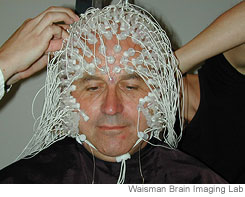 A good friend sent me this WSJ article: How Thinking Can Change the Brain. It makes the point that your brain can be fundamentally altered by your mind, your thoughts, if you will. Rather than the other way around.
 That's nice. But I sent my friend this reply, which is based upon some of my current reading, and it seems to resonate within me:
Ken Wilber has some thoughts on this type of investigation. Good to do, but don’t expect to understand consciousness from it.
In his book “A Brief History of Everything”, Wilber makes a distinction between the surface of things, and their depth. Understanding the brain from this materialistic/empirical examination would be gaining insight into its “surface”. But understanding the mind, and even more so, the spirit that perhaps moves the mind, cannot be seen in this way.
“... he can know what every atom of by brain is doing, and he still won’t know a single thought in my mind. This is really extraordinary. ..."
“... The interior dimension can only be accessed by communication and interpretation, by “dialogue” and “dialogical” approaches, which are not staring at exterior but sharing of interiors. Not objective by intersubjective. Not surfaces but depths.”
“You can point to the brain ... but you cannot simply point to envy, or pride, or consciousness, or value, or intention, or desire. Where is desire? Point to it. You can’t really ... because it’s largely an interior dimension ... This doesn’t mean it isn’t real!”
He goes on to explain how the Enlightenment — for all of its good — placed all of the West’s focus on this materialistic/empirical approach. For example, if someone is depressed, the “lab technician” approach would be to determine a lack of serotonin in the brain, and prescribe some Prozac. Never mind that the depression was caused by a lack of values, a lack of meaning to one’s life, perhaps an existential angst that resulted in the physiological manifestation of a lack of serotonin. And of course, you can take all of the Prozac that you like, and it may make you feel better, but it won’t give you meaning to your life.
I think he is on to something — this integral approach. And as a result, I am now less interested for science to “prove” the unique aspects that come about through meditation. Why not just do it yourself and see? Why not just interact and talk with others that are very experienced in mediation to help guide you and interpret the results. Who cares of I’m generating gamma rays or alpha rays? What meaning is there in any of that?
Just a thought. Thanks for the article. The part I found interesting was this acknowledgment: "This positive state is a skill that can be trained” Had the author said “learned” rather than “trained” I would have been more impressed. He continues to see his “patient/subject” as just one more lab animal to be studied, objectively, empirically, and monologically. Sigh. Maybe he should try talking to them.
Monday, January 15, 2007
On the necessity of conflict

OK, now here is an unpopular position. Life is conflict. Let’s deconstruct that.
So many people long for peace, or at least the absence of war. We wish to avoid the meaningless death of innocents. We ask to spare the children — what could they have possibly done to deserve this?
But what is life? It is evolution. And what is evolution? It is random genetic mutation, manifest into some quantum change, followed by adaptation to the environment, followed by natural selection — a weeding out of the less well-adapted beings, and thereby, a diminution and eventual pruning of some experimental branches, and the strengthening and growth of others. Over eons.
It is conflict that provides this selection process. Now this conflict can take many forms. Consider nature. It can take the form of inter- or intra-species struggle for food. It can take the form of famine or pestilence. It can take the form of natural catastrophes. Sometimes, you can see the selection process working, when an individual is not strong enough to survive. Other times it seems capricious and perhaps even unfair. But that is our ego labeling that which just is.
Consider the absence of conflict. Some see paradise. A return to the Garden of Eden, or the arrival of Heaven on earth. I see death. I see stagnation. I see the corrupting influence of gluttony, sloth, and apathy. Can you really be sure you would continue to advance, either consciously or physiologically if you were not challenged? And what causes this challenge, on a societal scale? Conflict (or competition — they are the same thing). So this "push" forward, if you will, is actually caused by conflict, not by peace.
So do not pray for an end to conflict. Pray for wisdom. Do not pray for avoidance of tragedy. Pray for compassion, love, and gratitude. For when you see conflict and tragedy, know that you see life, in all of its complexity and elegance; its simplicity and its beauty. To wish for a world without conflict is like wishing for a sun that never sets, a sky that never rains, animals that never eat, or humans that never die. Think for a moment and you can imagine the immediate catastrophe that would befall such an earth.

Instead embrace life (small “l”) while discovering Life (big “L”). See the beauty in the flow; the purpose of the process. The give and take. The gain and loss. The hope and fear. The joy and sorrow. Life cannot be another way. We are but humble actors in a grand play, and our progress — our evolution — may come from awakening to the noble truths that surround life as it is. Life is conflict. Life is suffering. (Some wise guy said that about 2500 years ago; we appear to be slow learners; not a good sign for our own evolution ;-) Awaken to that reality. Accept it and detach from your egoic desires. And from that Authentic Self — offer Love and Compassion to all sentient beings. While they struggle to awaken themselves. And yes, while they kill.
Sunday, January 14, 2007
On Integrity

I found this abridged quote somewhere on the ‘net, but can no longer find the source. At least I can attribute the thoughts to the correct individual. In what follows, Mark Gerzon does a nice job tying together the loose ends that make up our individuality, and on what it means to have integrity. I encourage you to consider his views:
Integrity Grows From A Humbling Realization, Mark Gerzon
"The purpose of life is ... to know oneself. We cannot do so unless we learn to identify ourselves with all that lives." -- Mohandas K. Gandhi.
I have never seen a conflict in which everyone could see the whole. On the contrary, I have only experienced conflicts in which some, and usually all, of the "part-ies" were identified with the "part." They were, literally, "partisan."
This is the basic human condition, the natural worldview of organisms that are born, live and die as seemingly separate entities. When our bodies shout "Me first!" -- we listen. We are wired to survive, and to put our survival before others (an instinct which can be trumped by only one other: protecting our offspring). As a natural extension of our survival instinct, we tend to care more about the welfare of those near and dear to us than those who are, by whatever definition, far away. Our language provides convenient words for each: the first we call "us;" the latter, "them."
The challenge of integrity -- or integral vision, which literally means "seeing" or "holding" the whole -- is to balance this very natural allegiance to the part ("partisan") with an allegiance to what it is but a part of. [...]
This intention toward integrity -- from the Latin integer, meaning "undivided, untouched whole -- is our first, critical step toward transforming conflict. Because of our commitment to "hold" or to "see" the whole conflict, we can become part of the solution to the conflict rather than just adding our energy to it. [...]
Integrity grows out of the humbling realization that there are many ways of seeing the world, and that we cannot take our worldviews for granted. Doing so blinds us to the possibility that our worldviews may be incomplete, skewed or -- to oversimplify -- "wrong." If this is so, then no matter how noble our intentions may be ("freeing the people," "creating jobs," "protecting human rights," etc.), everything we do will backfire.
--Mark Gerzon
Thursday, December 07, 2006
The Window

The Window -- author unknown
Two men, both seriously ill, occupied the same hospital room. One man was allowed to sit up in his bed for an hour each afternoon to help drain the fluid from his lungs. His bed was next to the room's only window.
The other man had to spend all his time flat on his back. The men talked for hours on end. They spoke of their wives and families, their homes, their jobs, their involvement in the military service, where they had been on vacation.
And every afternoon when the man in the bed by the window could sit up, he would pass the time by describing to his roommate all the things he could see outside the window. The man in the other bed began to live for those one-hour periods where his world would be broadened and enlivened by all the activity and color of the world outside.
The window overlooked a park with a lovely lake. Ducks and swans played on the water while children sailed their model boats. Young lovers walked arm in arm amidst flowers of every color of the rainbow. Grand old trees graced the landscape, and a fine view of the city skyline could be seen in the distance.
As the man by the window described all this in exquisite detail, the man on the other side of the room would close his eyes and imagine the picturesque scene.
One warm afternoon the man by the window described a parade passing by. Although the other man couldn't hear the band - he could see it in his mind's eye as the gentleman by the window portrayed it with descriptive words. Days and weeks passed.
One morning, the day nurse arrived to bring water for their baths only to find the lifeless body of the man by the window, who had died peacefully in his sleep. She was saddened and called the hospital attendants to take the body away. As soon as it seemed appropriate, the other man asked if he could be moved next to the window. The nurse was happy to make the switch, and after making sure he was comfortable, she left him alone.
Slowly, painfully, he propped himself up on one elbow to take his first look at the world outside. Finally, he would have the joy of seeing it for himself.
He strained to slowly turn to look out the window beside the bed. It faced a blank wall. The man asked the nurse what could have compelled his deceased roommate who had described such wonderful things outside this window. The nurse responded that the man was blind and could not even see the wall.
She said, "Perhaps he just wanted to encourage you."
And so it is.
Listen to those who describe beauty, serenity, and peacefulness, for perhaps, they just wish to encourage you to see for yourself.
Wednesday, December 06, 2006
Symptoms of Inner Peace

Be on the lookout for symptoms of inner peace.
The hearts of a great many have already been exposed to inner peace and it is possible that people everywhere could come down with it in epidemic proportions. This could pose a serious threat to what has, up to now, been a fairly stable condition of conflict in the world.
Some signs to look for:
A tendency to think and act spontaneously rather than on fears based on past experiences.Be Forewarned!!! If you have all or even most of the above symptoms, please be advised that your condition may be too far advanced to turn back. If you are exposed to anyone exhibiting several of these symptoms, remain exposed at your own risk. This condition of inner peace is likely well into its infectious stage.-- Author unknown
An unmistakable ability to enjoy each moment.
A loss of interest in judging other people.
A loss of interest in interpreting the actions of others.
A loss of interest in conflict.
A loss of the ability to worry. (This is a very serious symptom.)
Frequent, overwhelming episodes of appreciation.
Contented feelings of connectedness with others and nature.
Frequent attacks of smiling.
An increasing tendency to let things happen rather than make them happen.
An increased susceptibility to the love offered by others as well as the uncontrollable urge to extend it.
Monday, December 04, 2006
The chains that bind you

These are some honking chains. I believe they are used for battleships -- each link is about a foot long.
We all have many chains that binds us from being what we want to be, or all we are capable of becoming. Of course, that depends on what you want, and ultimately, that may be to realize just what your biggest chains are.
I hope these quotes help you realize that in the end, the most significant chains are all self imposed, and while they appear real and substantial like the chains in this picture, in fact they are as insubstantial as gossamer, which you will understand with the proper insight.
"The important thing is this:
To be able at any moment to sacrifice what we are
for what we could become."
-- Charles Dubois
"The fountain of content must spring up in the mind, and he who hath so little knowledge of human nature as to seek happiness by changing anything but his own disposition, will waste his life in fruitless efforts and multiply the grief he proposes to remove."
-- Samuel Johnson
"The mind is your past. Die to your past and you will suddenly become fully conscious. The past is nothing but dead debris. Get rid of it and you will learn how to witness. When you die to your past, to your thoughts and your memories, then you will be fully in the present. When you truly exist in the present, you are simply witnessing. The past can only exist as long as there are thoughts. When the thoughts are eliminated, the past disappears and you abide in your own Self. The Self does nothing but witness. The Self is not a person - it is Pure Awareness. It is completely detached from all phenomena. It is the state of becoming the one subject, the core of your existence."
-- Mata Amritanandamayi
"Happiness is your choice.
Something will happen today.
You will be tempted to say that it made you happy.
It won't.
You will make you happy by taking pleasure in it.
Something else will happen today.
You will be tempted to say that it made you sad or angry.
It won't.
You will make you sad or angry by taking displeasure in it.
Lots of somethings will happen today.
Will you make them happy somethings?"
-- David Leonhardt, The Happy Guy
"Happiness is a butterfly,
which, when pursued,
is always just beyond your grasp,
but which, if you will sit down quietly,
may alight upon you."
-- Nathaniel Hawthorne
"Man does not know if he will live another moment,
Yet his thoughts are ten million and more."
-- Thirukkural
Restroom sign:
"At the feast of ego everyone leaves hungry."
-- Bentley's House of Coffee and Tea, Tucson, AZ
Friday, September 29, 2006
Oil or Water?
 You may have seen this photo on another of my blogs recently, but it just fit too well with this post not to use it again. Sorry for the duplication.
We hear a lot of talk about oil these days. Soaring prices (though we feel a temporary respite at the moment). The source of middle east strife, propped-up monarchies, reasons for war, etc. Increasing world energy demands, decreasing supplies, etc. Global warming, pollution, etc.
But let's talk about something that is only simmering on the back burner right now -- don't worry, it will come to a boil soon enough: water.
I recently visited India, in particular the city of New Delhi with a visit to Agra. This was a business trip, and as such, I was put up in the highest of the high rent districts, in amongst the diplomatic housing. For any that have traveled, even in this country, that is surely the nicest of the nice areas. And it was.
Sure, you could drive a short distance and still find slums and shacks, but this city looked like it had some modern potential. It looked like there was a plan. It seemed from this very limited perspective as if the tide was coming in, and perhaps it would lift all boats.
Then just today, I read this article in the New York Times. If you have a minute, I commend it to you.
Here is a brief abstract to make my point, and the rest of the article paints conditions significantly more dire. But this is how it appears to some in the middle class:
The quest for water can drive a woman mad.
Ask Ritu Prasher. Every day, Mrs. Prasher, a homemaker in a middle-class neighborhood of this capital, rises at 6:30 a.m. and begins fretting about water.
It is a rare morning when water trickles through the pipes. More often, not a drop will come. So Mrs. Prasher will have to call a private water tanker, wait for it to show up, call again, wait some more and worry about whether enough buckets are filled in the bathroom in case no water arrives.
“Your whole day goes just planning how you’ll get water,” a weary Mrs. Prasher, 45, recounted one morning this summer, cellphone in hand and ready to press redial for the water tanker. “You become so edgy all the time.”
In the richest city in India, with the nation’s economy marching ahead at an enviable clip, middle-class people like Mrs. Prasher are reduced to foraging for water.
Take a moment and close your eyes. Now just imagine that the basic infrastructure of clean, abundant water and functioning(out-of-sight) sanitation is gone or severely disrupted. Try to imagine how your life would be different. Lacking clean drinking water. Uncertain if you will turn on your faucet and get potable water, or frankly any water at all. And the situation gets worse over time, as the population around you swells, ground water supplies continue to shrink, and competition for this most basic of life's necessities increases. The stress would be unimaginable. You would start fighting for water (not oil) -- the lifeblood of mankind.
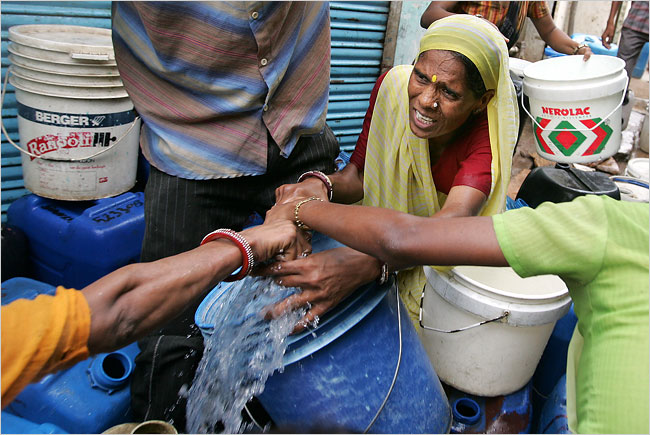 Source: NYTimes article cited above.
Of course it is so very hard to get into this mindset. We would just move if conditions around us got that bad. But you have to take a broader view. New Delhi is the most modern of India's cities. Elsewhere, things are worse.
 Source: NYTimes article cited above. Click on the graphic to enlarge it.
So what is my point? First, as India promotes itself as the largest emerging democracy, it is sobering that so many basic necessities are still lacking. India has placed a premium on education as the means to bring itself out of colonial times and onto the world stage. It is, after all, now a nuclear power. And yet that technical prowess has yet to manifest into satisfying basic necessities. To me that seems to be the most basic role of Government and its leaders.
And second, now please consider your own situation. Perhaps worrying about whether to get the 42" plasma TV or the 44" LCD HDTV is really not worth fretting about.
I'm sorry. I don't mean to be snide. I just mean that when you think life isn't giving you everything you want, maybe that's because it has given you everything you need. So maybe boundless gratitude should replace any anxiety. And after reveling in that gratitude, think about what you can do to ensure that our sons and daughters will have at least as much of life's needs provided for them as well.
Now I think I'm going to have a nice cup of tea, from my magic faucet that just keeps providing and providing glorious, clean, refreshing, water. The true elixir of life.
Sunday, September 24, 2006
Simply a world citizen
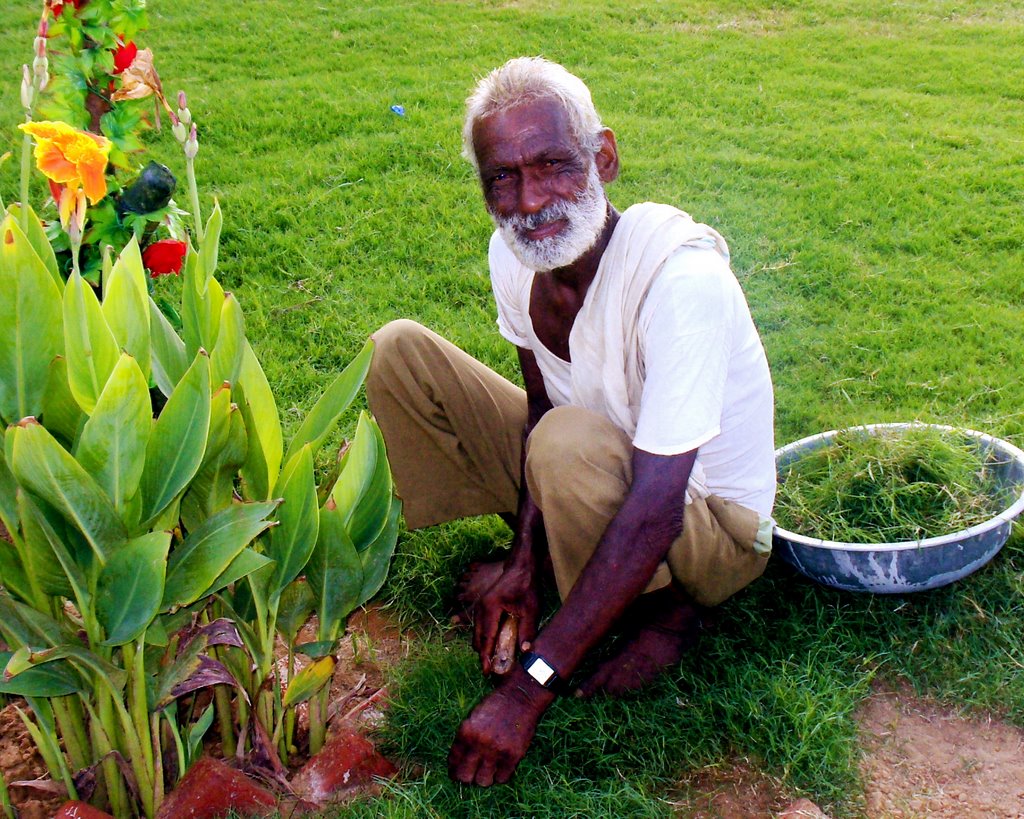
In the past I have quoted from The Happy Guy, who kindly sends out daily e-mails if you are so inclined. This one came with a link to what David Leonhardt calls a World Happiness Manifesto. Have a look and see what you think, and see if any of it resonates somewhere deep within you. If so, feel free to copy it as per his instructions below. In any case, you may want to probe a little more deeply into this mindset.
World Happiness Manifesto
My personal manifesto for a better world
I am a member of the human race. The only race I recognize is my own -- the human race.
Members of my race are carbon-based bipods, with one head and one heart. They all smile. They all despair. They all feel anger and pain. They all feel joy and hope. They see. They smell. They hear. They learn. They love. They seek happiness for self and for others.
Members of my race speak many tongues, wear their skin and hair in a variety of hues, choose from thousands of occupations and live in a multitude of places. They are all good. They are all worthwhile. They are all human. In my world, the only racism is love of the human race.
I am a citizen of the world. I recognize my overriding responsibility to be a good citizen. To care for my fellow citizens. To share with my fellow citizens. To be a good steward of the planet and its resources, for the wellbeing of my fellow citizens and of future generations. The absence of a world government in no way diminishes my obligations of citizenship or my sense of belonging.
As a citizen of the world, I recognize local governments. I pay my local taxes. I obey local ordinances. I salute my local flag. I protect my neighbors and their rights. My responsibility to my neighbors and to my local government is part of my citizenship in the world.
It is a sad reality that many local governments do not recognize my citizenship in the world. I pray for the day when no person shall be called an “alien" anywhere in my world.
I am a child of God. I reside in my family home with my brothers and sisters. Some have heard the voice of God and some have not. I do not begrudge those who have heard the voice, nor those who have not.
To the best of my ability, despite my many weaknesses, I will endeavor to do God’s will. I recognize that most of my brothers and sisters also do their best to follow God’s will, even when the message they are following sounds different than what I have heard. I will not second-guess God’s message to others; I respect God’s divine right and wisdom to send different messages to each of us children.
I am an instrument of peace. Happiness and peace go hand-in-hand. Complete happiness might be unattainable on this planet, but it remains crucial that we never stop striving for it. Therefore, we must all be instruments of peace.
Members of every race sometimes fight amongst themselves. As a member of the human race, I will strive to promote understanding amongst humans and to reduce conflict within our race.
Members of every nation sometimes bicker amongst themselves. As a citizen of the world, I will strive to promote understanding amongst citizens everywhere and to reduce conflict across our planet.
Members of every family sometimes quarrel amongst themselves. As a child of God, I will strive to promote understanding amongst my brothers and sisters and to reduce conflict within our family.
Attribution
This world happiness manifesto is reproduced from the original World Happiness Manifesto, a production of The Happy Guy’s happiness center
Republish the World Happiness Manifesto
Not everybody will agree with every detail in the World Happiness Manifesto above. However, if the bulk of these principles speaks to you, you are invited to select one of the republishing options below for your website:
Click here for code to republish without changes. Please keep this code completely intact.
Click here for code to publish an amended version. If you choose this option, please keep the attribution statement intact.
Wednesday, September 20, 2006
On Unconditional Love
I made a recent post over at Reflections of Beauty having to do with Love. And I've been having a dialog in the comment section with Mr. Anonymous. I thought I'd like to share some of that, since you might not have stumbled upon it. Here is an edited version of the conversation:
Mr. Anon: Now Love - there's a subject. What a power in our lives. Coming upon us unexpectedly, turning our lives over and over again. Takes us out of ourselves and makes us forget ourselves like nothing else can. But what is Love? It is Gift and Mystery - like Life itself. And when Love focuses on someone, it is one of the strongest addictions we can have, and one of the most difficult to deal with.Thanks for the comment, and yes, I can see that such love as you describe can be a tremendous force -- a powerful emotion -- exhilarating or debilitating, depending on the outcome.
But for the record, I was going for unconditional love -- you've described something else entirely. Unconditional love can include passion, but at the same time, dispassion for the outcome. Detachment, selfless caring for the other's well-being. What say you about that?
Mr. Anon: Well, I guess I did not communicate well because I was talking about unconditional love. When I fall for these women in my life (except for times when I am just playing around, or recreating), it is unconditional, and total. And that is why it is so painful when it ends; these endings usually leave me so totally spent, lost, betrayed, and wandering in an unknown land, and of course, wondering at the meaning of life, and at this mysterious Human Condition that we are enduring. If it was anything less than unconditional, then ou might say, ah! then it does not end, you still have it! Forever, and always in your Heart. And of course, I agree with that. That love is still there. But the object of my love is not longer beside me - and that is the hard part. Not seeing his or her face beside me anymore when I wake up.I certainly do not mean to debate with you. And words are such a terrible medium to communicate about such intense feelings.
[Now you] say you wrote about something entiredly different than I did. That confuses me. I can't understand that comment. Are you confusing unconditional love with compassion? Love always has an object doesn't it? Are you talking about some kind of objectless love? I am pretty clear about the love I am pointing at. Been in and out of it enough times (and everytime is different). But now, I am getting confusing about what it is you are talking about, specially when you "entiredly something else" it throws me for a big loop.
I think many people do not understand what love is, or at least what is can be. Maybe we all make up our own versions of it.
But when I refer to unconditional love, it is such that you will not have such pain. Do you feel pain when the butterflies migrate south? Do you have pain when your enemy becomes your friend? Do you have pain when your child grows up and begins his own life?
Unconditional love in my mind does not cause pain. You are giving it freely (unconditinoally -- expecting, needing, wanting -- nothing in return). You are happy to give it. So then how can it cause you pain? It has already caused you happiness to give it away?
The love you describe -- to me anyways -- sounds like a different kind of love. One that expects, however gently, to receive love back. For example, you would think I might have unconditional love for my wife, right? How can I offer unconditional love to others, if not my wife?
Becuase I so much want her love in return. It would wound me to the core if she did not love me back.
And that is OK. That's what makes a marriage. Which brings children that we want to let go -- to see grow in their own ways. To evolve to their own future. Which is of course, life itself.
Mr. Anon: Ah so! Your description above of unconditional love as being painless because it needs nothing in return, is interesting. It sounds like a riskless way to love. And you were right - that is not the "unconditional love" that I was talking about.I definitely don't think it is genetic -- except perhaps differently than you imply (that some few have it, and others cannot). If anything, I believe everyone of us is capable of expressing this type of love, and yes, as you say I would describe it something as a state of being.
Actually, the unconditional love that you are talking about seems to me almost like a "state of being."
To my way of thinking, what you are talking about is something that not all of us can experience, but only some very lucky beings among us who happen to be (for some reason or other, maybe genetics) blessed with a state of being so complete, fulfilling, and pleasurable (if not ecstatic).
A great question is: for the many people out there who have no knowledge of this way of being, or for those who know it, but are unable to sustain it - is it possible to enlighten them? Possible to help them reach to that state, and maintain it? Or is it just something that you have, or you don't have (for example, like physical beauty)?
As for how to come to this realization. Well, I believe the primary action would be to have the intention to be in this state. Once that notion is internalized, I believe it will drive one to invesitgate what path would work best for them to uncover this inherent potentialilty. I suspect the path is different for everyone. Hence all of our religions, our cultures, our squabbles, etc.
I believe the insights, truth, beauty, englightement, call it what you may, exists within. Perhaps that is the "genetic" seed that we all share. Personally, I believe our egos tend to mask this insight, and actually work activtely to oppose it. Why you ask? Beuase, I suspect, of our current state of evolution -- we still carry this baggage of "survival of the fittest", and the ego is our tool to help us to survive and reproduce.
Ultimately, one needs to transcend the ego, and recognize that our individuality is but an illusion. Once there, unconditional love is rather a natural state -- why would you not love another, if that is just a different manifestation of your true Self.
But again -- your path may be different. As Jesus' was -- as Buddha's was -- as Gandhi's was.
I hope this help you understand my thinking; and I hope it is helpful for you as well. Namaste.
Wednesday, September 13, 2006
On Judgment

Have you ever thought about judgment? Well, why not think about it for a minute. It is simply a human phenomenon — it doesn’t occur in nature.
Do you think this bird is worried about its hairdo? Are his friends embarrased to be around him? Animals don’t have bad hair days. Are you having a bad hair day?
It’s really rather profound, when you stop and think about it. Nature doesn’t think about “good” and “bad” -- it doesn’t judge things. Things just are.
As I consider this, I realize judgment is a purely human phenomenon. And boy are we good at it. Or bad at it. ;-) Either way, we certainly judge. We pass judgment on our past. We even prejudge things that haven't hapened yet -- and worry about what the future will bring. And with that come all of our prejudices. We judge both our friends and our enemies. We judge our lifestyle and most especially the lifestyles of others.
And then there is God. We’re not satisfied with all of the judging we are doing, so many of us define God (or accept others' definitions) as the ultimate judge and jury — guaranteed to judge every act you’ve ever done or not done — and sentence you accordingly. According to his beliefs about what is right and wrong, good and evil — which just happen to match your beliefs (or vice versa).
Newsflash: God, by whatever name you give him/her/it, doesn't judge. Leave behind your thoughts of everlasting damnation. Ultimate retribution. Or even eternal paradise. All of these attributes are the creation of man.
Consider what the world would be like if we escaped from this part of the human condition. If we opted out of all of the judging. If in the immortal words of Lennon and McCarthy, we just “let it be”.
Then you would see life as it really is. You would appreciate its splender as it unfolds. You would avoid the labeling, which is connected to judgment. You would just recognize your presence in the glorious creation, and be able to appreciate it all -- what others call both good and bad.
And you really wouldn't care what others might think of your hairdo.
Subscribe to:
Posts (Atom)